报告详情
Ensemble-Based Covariance Inflation in Cycling Data Assimilation With AI Weather Models
编号:87
访问权限:仅限参会人
更新:2026-07-31 21:50:20 浏览:10次
张贴报告
摘要
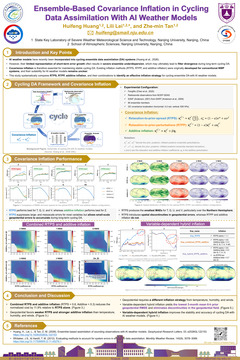
Artificial intelligence (AI) weather models have recently been incorporated into cycling ensemble data assimilation (DA) systems. However, their limited representation of short-term error growth often results in severe ensemble underdispersion, threatening the long-term stability of cycling DA. Covariance inflation is therefore essential for maintaining stable cycling, but inflation methods originally developed for conventional numerical weather prediction may not be directly applicable to AI weather models. This study systematically compares relaxation-to-prior-spread (RTPS), relaxation-to-prior-perturbations (RTPP), and additive inflation within a cycling ensemble DA framework based on the FengWu AI weather model. The comparison is based on cycling DA experiments assimilating real-time radiosonde observations, with inflation parameters optimized before evaluating the different methods. Among the three inflation methods, RTPS yields the lowest prior RMSEs for temperature, specific humidity, u‐ and v‐ wind components, whereas additive inflation yields the lowest geopotential errors. RTPS suppresses large- and mesoscale errors for most variables but allows small-scale geopotential errors to accumulate, leading to spatially discontinuous error patterns during long-term cycling DA. A combination of RTPS and additive inflation is subsequently optimized using a two-dimensional parameter search. The optimal configuration, with an RTPS coefficient of 0.6 and an additive inflation amplitude of 0.3, reduces the multivariable normalized cost by 11.8% and 6.5% compared with RTPS inflation alone and additive inflation alone, respectively. Parameter sensitivity analyses further reveal that geopotential favors weaker RTPS and stronger additive inflation than the other state variables. Motivated by this contrast, a hybrid inflation strategy is proposed in which geopotential uses additive inflation alone, whereas temperature, specific humidity, and winds use the combined RTPS and additive inflation scheme. This configuration achieves the lowest 3-month mean prior error and eliminates geopotential error discontinuities. These results demonstrate that geopotential should be treated differently from the other state variables when designing inflation schemes for ensemble-based cycling DA with AI weather models, leading to improved cycling stability and forecast accuracy.
关键词
AI weather models,Cycling data assimilation,Covariance inflation
报告人

黄汇丰
学生 南京大学稿件作者
全部评论
重要日期
-
会议日期
08月12日
2026
至08月15日
2026
-
08月05日 2026
初稿截稿日期
-
08月12日 2026
注册截止日期
主办单位
成都信息工程大学
承办单位
成都信息工程大学
联系方式
历届会议
-
2025年08月15日 中国 大同市
第七届全国中尺度气象学研讨会 -
2021年01月14日 中国 南京市
第三届全国中尺度气象学论坛


发表评论