报告详情
Anatomy-Aware Vision-Language Learning for Medical Image Interpretation
摘要
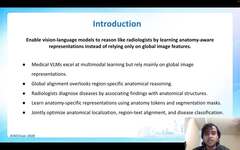
Vision-language modeling has significantly advanced radiology by enabling models that jointly learn from medical images and radiology reports for tasks such as disease classification, report generation, and visual question answering. However, most existing approaches treat an entire medical image as a single entity during image-text alignment, overlooking the fine-grained anatomical reasoning process employed by radiologists. In clinical practice, radiologists systematically examine individual anatomical regions, associate findings with specific structures, and integrate these region-specific observations before arriving at a conclusion about the image as a whole. To address this limitation, we propose an anatomy-aware vision-language framework that learns anatomy-specific representations using dedicated anatomy tokens and anatomical segmentation masks. The framework further incorporates context-aware anatomical representations and jointly learns anatomical localization, aligns anatomical regions with their corresponding findings, and aligns global image representations with image-level disease categories within a unified vision-language framework. Extensive experiments on out-of-distribution datasets demonstrate the effectiveness of the proposed framework. The model achieves strong performance in zero-shot disease classification and anatomical segmentation, demonstrating robust generalization to unseen data and accurate localization of anatomical structures. Comprehensive ablation studies further validate the contribution of each component and the effectiveness of the proposed design choices.
关键词
报告人

Shahab Ahmad Khan
Student University of Wisconsin–Madison稿件作者
全部评论
重要日期
-
会议日期
07月30日
2026
至08月01日
2026
-
07月28日 2026
初稿截稿日期
-
08月03日 2026
注册截止日期
主办单位
承办单位
协办单位
IEEE Madras Section
联系方式
- ICNCCom 2026
- ic******@usssociety.org
历届会议
-
2026年07月30日 印度 Trichy
2026 International Conference on Networks Computers and Communications


发表评论