报告详情
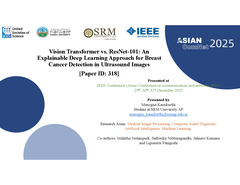
Vision Transformer vs. ResNet-101: An Explainable Deep Learning Approach for Breast Cancer Detection in Ultrasound Images
编号:82
访问权限:仅限参会人
更新:2025-12-21 13:01:15 浏览:509次
Online
摘要
Breast cancer remains a significant global health concern, where early and accurate diagnosis is paramount for improving patient survival rates. This paper presents a comparative analysis of two deep learning architectures, the Convolutional Neural Network (CNN) based ResNet-101 and the Vision Transformer (ViT), for the classification of breast ultrasound images into benign, malignant, and normal categories. Addressing the common challenge of limited data, we employed a data augmentation strategy to expand a benchmark dataset of 780 images to over 10,000 images, creating a robust training set. Both models were trained on this augmented dataset, achieving test accuracies of 98.64% for the Transformer model and 97.57% for Resnet-101 model. The result indicates that the ViT model achieved higher accuracy than the ResNet-101. Furthermore, the existing Deep learning models are black box models. To enhance model transparency and build clinical trust, Gradient-weighted Class Activation Mapping (Grad-CAM), an Explainable AI (XAI) technique, is utilized to generate visual heatmaps, highlighting the specific regions in the ultrasound images that were most influential in the models’ diagnostic decisions. The proposed model harnesses GPU-based parallel infrastructure.
关键词
Breast Cancer, Deep Learning, ResNet-101, Vision Transformer, Explainable AI, Grad-CAM
报告人

Lipismita Panigrahi
Assistant Professor SRM University-Amaravati稿件作者
全部评论
重要日期
-
会议日期
12月29日
2025
至12月31日
2025
-
12月20日 2025
初稿截稿日期
-
12月31日 2025
报告提交截止日期
-
12月31日 2025
注册截止日期
主办单位
国际科学联合会
承办单位
扎尔卡大学
联系方式
- Miss AsianComNet
- as******@usssociety.org
历届会议
-
2024年10月24日 泰国 Bangkok
2024亚洲通讯与网络会议


发表评论