报告详情
Two-timescale Beamforming Optimization for Intelligent Reflecting Surface Enhanced Wireless Network
编号:159
访问权限:仅限参会人
更新:2020-08-05 10:17:28 浏览:1069次
口头报告
摘要
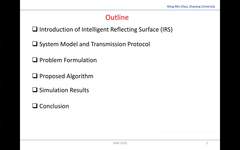
Intelligent reflecting surface (IRS) has drawn a lot of attention recently as a promising new solution to achieve high spectral and energy efficiency for future wireless networks. Prior works on IRS mainly rely on the instantaneous channel state information (I-CSI), which, however, is practically difficult to obtain for IRS-associated links due to its passive operation and large number of elements. To overcome this difficulty, we propose in this paper a new two-timescale (TTS) transmission protocol to maximize the achievable average sum-rate for an IRS-aided multiuser system. Specifically, the passive IRS phase-shifts are first optimized based on the statistical CSI (S-CSI) of all links, which varies much slowly as compared to their I-CSI, while the transmit beamforming/precoding vectors at the access point (AP) are then designed to cater to the I-CSI of the users' effective channels with the optimized IRS phase-shifts, thus significantly reducing the channel training overhead and passive beamforming complexity over the existing schemes based on the I-CSI of all channels. Simulation results are presented to validate the effectiveness of our proposed algorithm.
关键词
暂无
报告人

Ming-Min Zhao
Zhejiang University, China稿件作者
全部评论
重要日期
-
会议日期
06月08日
2020
至06月11日
2020
-
01月12日 2020
初稿截稿日期
-
04月15日 2020
提前注册日期
-
12月31日 2020
注册截止日期
主办单位
IEEE Signal Processing Society
承办单位
Zhejiang University
联系方式
- Prof. Zhiguo Shi
- zj******@gmail.com
历届会议
-
2014年06月22日 西班牙
2014 IEEE第8届传感器阵列和多通道信号处理研讨会


发表评论